
Technology
Gasolfin's catalytic system consisting of modified zeolites converts any C4–C11 naphtha into 64–88 wt% light olefins, enabling long operating cycles by minimizing coke yield (<0.5 wt%). Its low coke yield enables fixed-bed reactor operations and reduces emissions versus competing technologies.
How does it work?
Scroll down to learn more
Gasolfin converts low-value naphthas into high-value olefins
Light naphtha is one of the lowest-value streams a refinery makes. Gasolfin's catalyst cracks it into ethylene, propylene and butylene, the building blocks of the global petrochemical industry.
- The feedstock is delivered to the Gasolfin feed drum, and combined with recycle (non-converted feed)
- The reactor effluent exchanges heat with the feed, and the heated feed is delivered to the reactor inlet
- Low-value molecules are converted into light olefins
- The effluent is air-cooled after exchanging heat with the feed, and flashed in a single-stage equilibrium flash drum
- The light gases are compressed and sent to product recovery
- Any convertible feed that escapes out the flash drum overhead is captured in a debutanizer and is returned to the feed
- The Gasolfin operator sets the reactor inlet temperature according to the desired level of conversion
- The Gasolfin catalyst produces a stable yield selectivity at all conversion levels, enabling smooth product recovery
Gasolfin's catalytic system consisting of modified zeolites minimizes coke yield
Cracking naphtha typically requires the catalyst to be continuously regenerated due to coke formation. Gasolfin's zeolite system modulates the active sites, suppressing coke yield while maintaining reaction speed.
- The catalyst is an extrudate with exceptional crush strength
- The low coke technology limits the catalyst's exposure to the high temperatures during regeneration, increasing catalyst life
As a result, Gasolfin can make use of fixed-bed reactor operations
The reactor vessel is packed with catalyst, feed runs down through it, and product comes out at the bottom. This design is much simpler than competing technologies such as FCC units and PDH.
- Gasolfin focuses its efforts on the catalyst technology and relies on well-understood, long-operated unit operations
- Gasolfin relies on simulated moving bed operation with two or more reactors in cracking mode with one additional reactor in regeneration/stand-by mode
- The fixed bed eliminates the challenges associated with moving beds, which include: bridging, pressure lock chambers, attrition losses, etc.
- Similarly, Gasolfin avoids the challenges of fluidized beds: operating in the narrow window between incipient bubbling and fluidization, maintaining air distribution grid integrity, large numbers of cyclones and flue gas scrubbers, ESPs, etc.
- The Gasolfin reaction section is similar to a hydrotreater or catalytic reformer – simple!
Gasolfin cracks any C4–C11 naphtha, including pentanes
Feed enters the reactor as a vapor and passes down through the bed. The same Gasolfin unit converts feed from a crude unit, hydrotreater, coker or FCC, and all bio-naphtha, pyrolysis oil or e-naphtha sources.
- The standard Gasolfin operation converts all non-aromatic molecules boiling between C5 and C11
- Converts normal and isopentane into primarily propylene and ethylene
- Gasolfin is insensitive to most feed poisons except nitrogen, alkali metals, halogens, etc.
Gasolfin produces 64–88 wt% high-value light olefins
Product is drawn off below the bed and sent to recovery, and unconverted feed is recycled. Nothing heavier than the feed comes out: no diesel or cycle oil. Propylene leads on every feedstock Gasolfin has run.
- Gasolfin is the world's first light-ends conversion unit
- Fluidized Catalytic Cracking (FCC), Delayed Coking, Hydrocracking and other similar processes are designed to upgrade a low-value residue into high-value motor fuels
- Gasolfin similarly upgrades the low-octane, high vapor pressure (RVP) portion of the gasoline pool into higher-value olefins (ethylene, propylene, butylene)
- Olefins are often valued at two to three times the value of gasoline
What does it do?
Cycle length
A typical cycle lasts four to five days, depending on the feedstock composition. A feed rich in pentanes runs a somewhat shorter cycle than one rich in hexanes or heptanes. Total olefin selectivity rises steadily over the first one to two days of a cycle, then holds constant for the rest of the run.
Each reactor stays on stream for a defined cycle, comes offline for in-situ decoking, and then goes back into service. Gasolfin relies on simulated moving bed operation with two or more reactors in cracking mode with one additional reactor in regeneration/stand-by mode.
Yield selectivities
The Gasolfin olefin yield selectivity is 64–88 wt%, depending on the composition of the feedstock. The catalyst converts every non-aromatic naphtha boiling-range hydrocarbon it is fed, from paraffinic light straight run through olefinic FCC naphtha, with varying ethylene-propylene-butylene splits. Olefinic feeds (FCC, pyrolysis) produce higher olefin yields.
Butylene can be recycled to 42.8 wt% ethylene and 57.2 wt% propylene, providing further feedstock optionality.
Select a feedstock
Emission intensity
Gasolfin emits 40–60% less CO₂ per tonne of olefins than steam crackers (naphtha and ethane), FCC units and PDH.
Four factors drive Gasolfin's lower emissions:
- Ultra-low coke formation (<0.5 wt%)
- Lower heat of reaction
- Narrow feed slate excl. anything outside naphtha range
- Heat integration across the recovery section
Want to learn more about the technology?
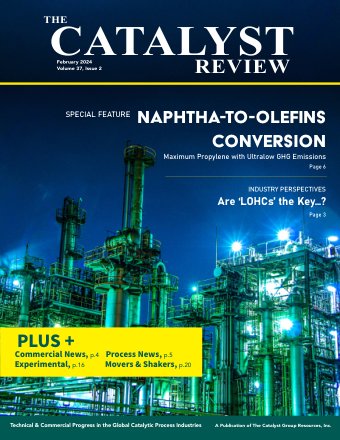
The Catalyst Review
February 2024
Read our special feature in The Catalyst Review
Gasolfin was the special feature of The Catalyst Review's February 2024 issue. Written by our CTO Ray Fletcher, it gives further insight into the technology.

Ray Fletcher
Chief Technology Officer
Reach out to our Chief Technology Officer
With over 35 years of experience in process engineering and over 25 global patents commercialized, Ray is well-positioned to answer any questions on the Gasolfin technology.